- Discover Britain
- Essential
information
- Accidents and emergencies
- Pounds and pennies
- Hotel search
- Budget tourism - Britain on the cheap
- Online shopping from the UK
- Driving in Britain
- Low-cost car-hire
- Travel by train in Britain
- Visitor accommodation
- Hotels in London
- Britain's main attractions
- Food and eating in Britain
- Christmas in Britain
- English pubs
- Places
to visit
- Britain's main attractions
- Visiting London
- London for free
- Getting round in London
- Shopping in London
- More great English cities
- Oxford and Cambridge
- Best places to visit in southeast England
- Best places to visit in central southern England
- The West of England - Gloucestershire to Dorset
- The southwest - Devon and Cornwall
- Sites & heritage in the East of England
- About Scotland
- Attractions by theme
- Issues & institutions
About-Britain.com
- a thematic guide to Britain
Discover
Scotland - a short introduction
| Index | Scotland and its people | Areas of Scotland |
| Main cities of Scotland | Scottish specialities | Major tourist attractions |
Accommodation :
Hotels,
cottages or b&bs
find the best offers from Booking.com:
find the best offers from Booking.com:
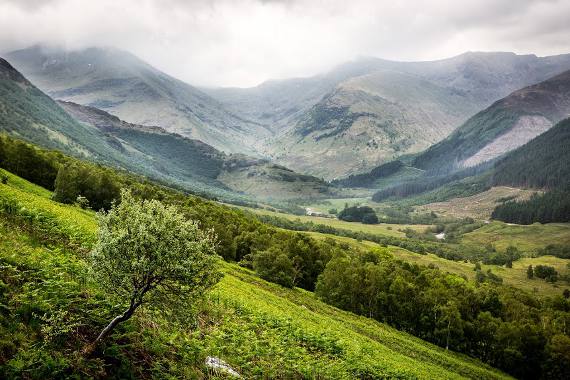
Highland
landscape
Scotland and its people
Population density
With just 68 people per sq. km. (compared to over 400 per sq.km. in England), Scotland is one of the least densely-populated countries in the European Union. In the Scottish Highlands and Islands, the population density falls to just 9 people per sq. km, making this one of the most sparsely populated areas of Europe, comparable only to northern Scandinavia.Scotland and Europe
At the 2016 referendum, Scotland voted by a majority of 58% to remain in the European Union. But when the UK left the European Union in 2020, Scotland could no longer remain as it is not a sovereign state.The Scottish National party, the SNP, is in government in the Parliament of Scotland, and has 48 of the 58 Scottish MPs in the UK parliament in London. The SNP is demanding a new referendum on Scottish independence, but the government in London has refused. Will Scotland eventually become independent again? Time will tell....
Reaching Scotland
By air
Glasgow and Edinburgh airports are well served by low-cost and traditional airlines, with direct flights from airports all over Europe and from North America.By sea and drive
The easiest way to reach Scotland from Europe with a car is to take the DFDS Ferry from Amsterdam to Newcastle, avoiding hundreds of kilometers of busy motorways through England. The easiest way to drive from London is to use the M1 - M6 - M74 route, the "west coast" route via Carlisle.By train.
Direct trains to Edinburgh and Aberdeen run from London's Kings Cross station. Direct services on the west coast route to Glasgow run from London's Euston station. For train tickets see The TrainlineAreas of Scotland
In geographical and economic terms, Scotland can be divided into four areas:- the Borders, being the hill country of the southern part of Scotland. Increasingly forested hills and valleys with a number of small towns, and some famous salmon fishing rivers
- the Central Lowlands, the valleys of the Forth and Clyde, including the cities of Edinburgh Glasgow and Stirling. This area is home to the majority of the population of Scotland, and comprises a mix of urban and rural areas.
- the Eastern Lowlands, from the Tay to the Moray Firth, including the cities of Dundee and Aberdeen. This area includes much rich and fertile agricultural land, notably between the river Tay and the Grampian mountains
- the Highlands and Islands - beginning just north of Glasgow, Stirling and Dundee, the Highlands are a much larger area than the eponymous administrative area. They include several of the highest peaks in Britain, notably the highest point, the summit of Ben Nevis at 1,344 m (4,409 ft).
Scotland's cities
Scotland has four large cities.- Edinburgh, on the Firth of Forth (a firth is etymologically the same word as fijord) , is the historic, cultural and administrative capital of Scotland. With its castle, art galleries, historic "New Town" (a UNESCO world heritage site), and fine shopping streets, It is arguably the most attractive large city in the British Isles, and a very popular tourist destination.
- Glasgow, to the west, on the Firth of Clyde, is the industrial capital of Scotland, and its largest city. Glasgow also has a strong cultural heritage and some major museums, and is close to a very attractive area called the Trossachs.
- Dundee, once famed for "Jute, Journals and Jam" is a former industrial city on the Firth of Tay, which has developed more modern high-tech specialisations in Video games and Life Sciences.
- Aberdeen north of Dundee on the east coast, is called the "Dallas" of Scotland, being the main shore base and centre for the UK North Sea oil industry, which has brought considerable wealth to the area.
Scottish specialities - the spirit and taste and sounds of Scotland
- Whisky - probably the best know spirit in the world, whisky (not whiskey) from Scotland, also known as Scotch, is a product that is intimately connected with the country. Scotch whisky comes in two main types - grain whisky and malt whisky. Most grain whisky is blended whisky, and this forms the majority of the production of Scotch whisky. Malt whisky, most often seen as Single malt whisky, is whisky produced from a single distilling in a single distillery. Single malts are the most prestigious and most expensive of Scotch whiskies. There are Highland malts, from the Scottish mainland, and Island malts, produced in the western Isles; the best-known Island whiskies are distilled on the islands of Islay, Skye and Jura.
- Shortbread - Famous Scottish butter biscuits
- Haggis - a historic Scots dish, made of minced spiced sheep's liver, lung and heart, with oats, chopped onion, and suet. And it is really tasty.
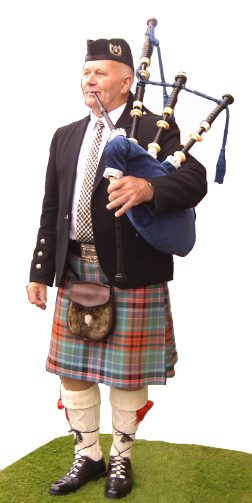
- The Kilt - traditional Scottish garment, worn by men instead of trousers, and also by women. A form of skirt, made from wool, and traditionally patterened in the wearer's clan tartan. It is formal dress for men, and for Scottish soldiers.
- Bagpipes. The unmistakable sound of Scotland, bagpipes are an ancient reed instrument, actually used in many parts of Europe. The Scottish version, with a chanter and one or two drones, is more complex and melodious than those found in many other parts.